Writer Jaydra Johnson on Street Books
A Scrappy Vision of Utopia
We at Street Books believe that, to reimagine a society that allows everyone a dignified life, we must begin by nurturing our city’s imagination. This year we’re imagining alongside Italo Calvino’s Invisible Cities: a book that questions what a city is, what it’s for. Street Books reaches across the many different Portlands to bridge gaps between housed and unhoused; between alienation and neighborly love. Every library shift is its own emotional city.
Invisible Cities is structured according to eleven themes that capture the many faces of a city. This week we are thinking about the theme of “Cities and the Eyes,” and how it feels to really see each other as humans, and to respect each others’ dignity, autonomy, and inner life. Earlier this year, Street Books was featured in a Portland Monthly article by writer Jaydra Johnson. Johnson joined our team of street librarians for a shift as part of her research process for the piece. Of course, the “emotional city” of a Street Books library shift contains so much more than can be captured in a single magazine article. Engaging with new people at the level of storytelling and shared interests is one way that we get to feel “seen.” She generously offered to share some of her reflections that didn’t make it into the Portland Monthly piece for our newsletter::
“The people gathered on the sidewalk were in varying states of wellness. One was asking around for Tylenol. Another requested wound care supplies to treat her brother’s foot injury. Another needed a tent. Not all these needs could be met—this was a library after all, not a shelter or clinic. In the face of these more urgent physical needs of Portland’s unhoused neighbors, it might seem naive to offer them literature, but that’s exactly what Street Books does.
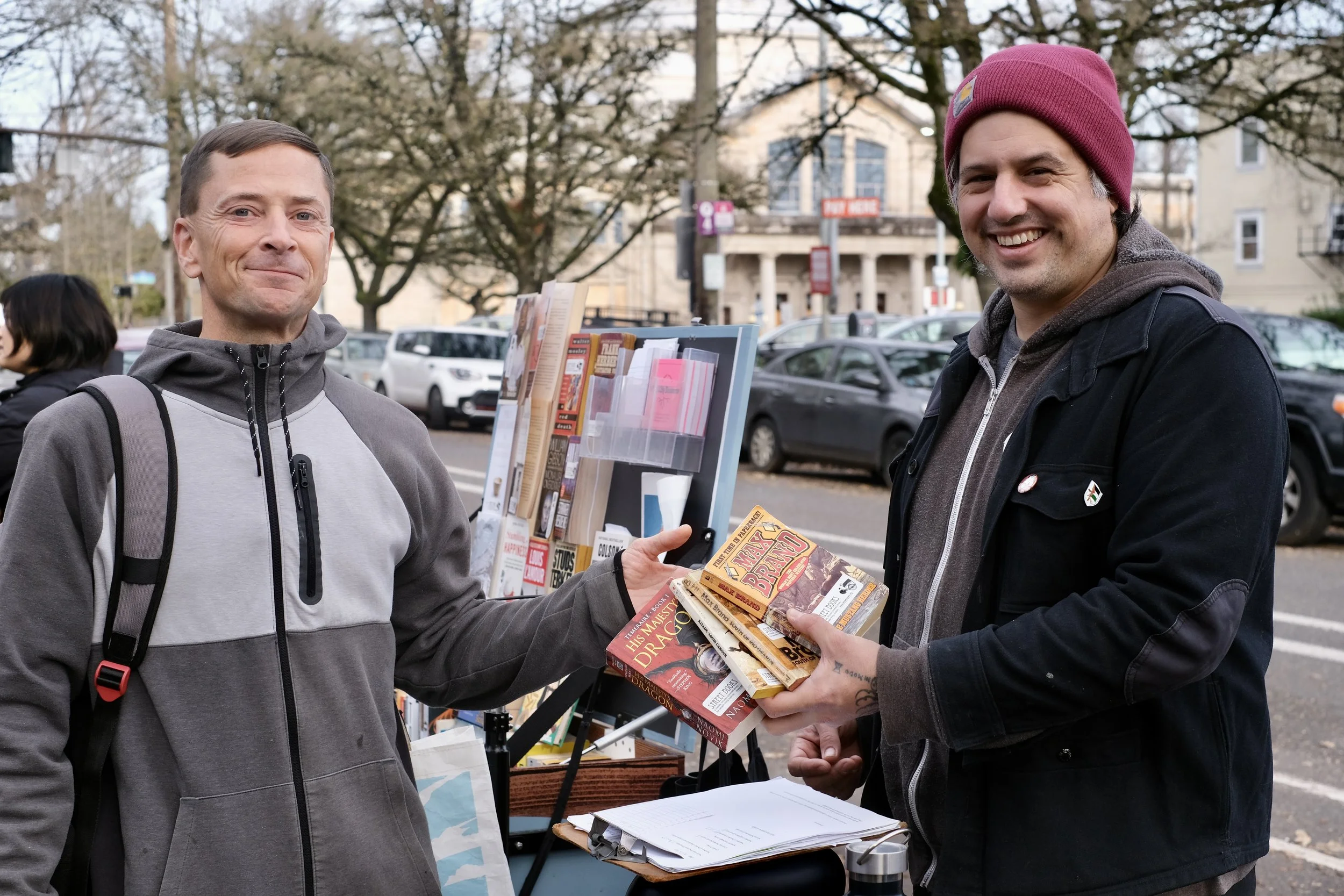
That’s one reason they started providing free naloxone alongside bestselling novels and crossword puzzle books. “One of the stated goals of Street Books is to meet our library patrons where they're at,” Pollock told me.” The library gave out over 3500 doses last year. “We're just trying to be one of those tender mercies,” Rempe said. Or, as Pollock put it, “You can't read a book if you're dead.”
A regular in a Harvard sweatshirt told me she was a published writer herself. As we talked about our writing practices, she performed one of her poems from memory. She asked what my book was about as she flipped through its pages (I had brought along a couple of copies for the cart) and said she was excited to read it. This is what Rempe had been talking about when she’d said, “Books have a kind of life to them that you can see.” Besides the poet who checked out my book, I met several other artists and writers during my short shift.
Pollock added that “It doesn't put a roof over someone's head, but it's an act of care where somebody feels loved, which I think also provides a type of fuel to keep going.”
Later, a woman called Pollock over to sit with her on a nearby bench, where she showed him her latest pages and outlined her plan for integrating them into a large collage. Another lamented to me the loss of all the notebooks filled with his writing in an encampment sweep.
Karen Russell is an award-winning author who has long supported scrappy Street Books because of the way they live out the values they espouse in their mission statement. To her, “There is something deeply radical and deeply good about Street Books.” It might sound hyperbolic, but when she said that her library shifts had been life-saving, I had to believe her. In this work, she glimpses something like utopia. “The gulf between ‘housing is a human right’ and where we are today can feel really insurmountable. But it's the long game,” she said.”
You can read Johnson’s feature on Street Books online at Portland Monthly, and check out more of her writing at jaydrajohnson.com
Street Books is committed to showing up consistently for our neighbors living outside and on the margins–in the face of societal problems that can feel insurmountable at times, one thing we can do is to care for each other as individuals and as humans. Can you help us continue to show up, rain or shine, to hold space for our collective humanity?
Click the button below to donate to our Winter Campaign through Give!Guide and help Street Books keep going through the months and years ahead. Every donation helps ensure we can continue to be a reliable resource for our community, regardless of the challenges we face. THANK YOU for making our work possible, there would be no Street Books without you!
📣 Support Oregon Cultural Organizations and Get A Credit on Your Taxes!

Your donation to the Oregon Cultural Trust helps support organizations like Street Books
Did you know, when you match your donation to Street Books and other OCT qualified non-profits with a gift to the Oregon Cultural Trust, you direct a portion of your state taxes to fund more than 1,600 cultural organizations? It’s true! And come tax time, you will receive up to a 100% refund in the form of a state tax credit. By using the Cultural Tax Credit, Oregonians and the Cultural Trust have awarded close to $40 million, and counting, to the cultural nonprofits that define our quality of life. Join us by taking your support of Oregon's arts, heritage and humanities to the next level. Make culture count.
Find out more here and thank you for supporting culture and arts in Oregon!